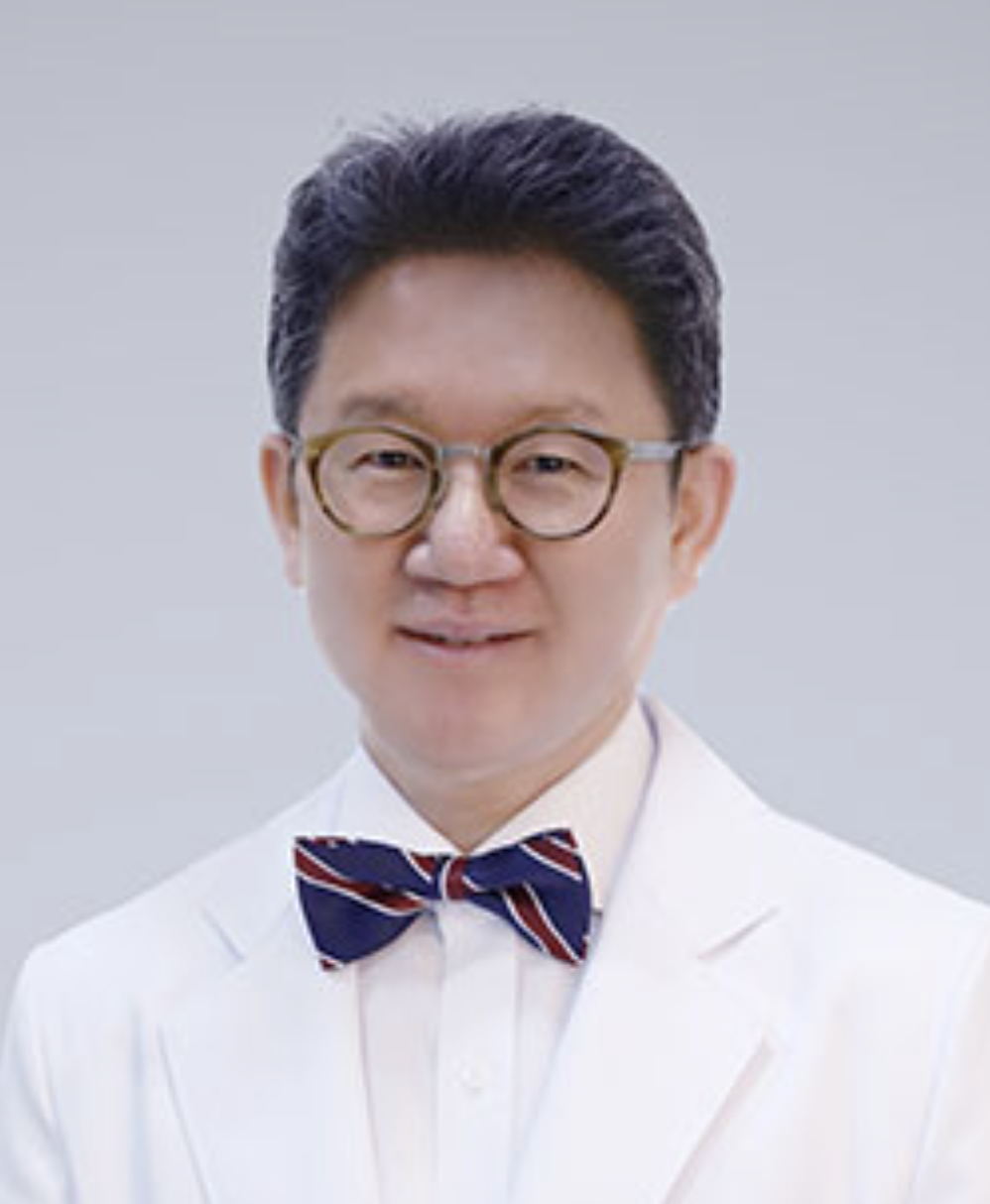
Dr. Sungjoo Hwang
• Board-certified dermatologist with 30+ years of experience in hair
transplantation
• Began full-time hair restoration practice in
1996 at Korea’s first hair
transplant center
• Pioneer in introducing
medical and surgical hair loss treatments in
Korea
• Key contributor to the stable adoption of
FUT and developer of
DCT
technique
• Specialist in
natural hairline design tailored to Korean/Asian facial
and scalp characteristics
• Emphasis on
strategic planning (scalp condition, density, balance)
beyond technical skill
• Proposed
Recipient Site Influence Theory based on self-
experimentation since 1998
• Recipient of
Korean Dermatological Association Best Paper Award
(2003) and
ISHRS Platinum Follicle Award (2006)
•
First Korean ABHRS-certified physician; former president of Asian,
Korean, and International hair restoration societies
• Current professor at
Myongji Hospital, providing integrated
surgical, medical, and SMP-based hair restoration care
Dr. Sungjoo Hwang is a board-certified dermatologist who has dedicated his career to advancing hair transplantation surgery in Korea. He has been active in both clinical practice and research, developing surgical techniques tailored to Korean patients and working to improve long-term outcomes in the field.
In 1996, when Korea’s first hair transplant center opened at Kyungpook National University Hospital, Dr. Hwang began his full-time work in hair restoration. At the time, hair loss was commonly viewed as a hereditary issue with limited treatment options, and surgical approaches were not widely known or accepted. Dr. Hwang helped introduce medical and procedural solutions to the broader public and medical community.
He played a key role in establishing the stable application of follicular unit transplantation (FUT) and developed methods like depth-controlled transplantation (DCT) to reduce complications such as folliculitis. He also focused on designing natural-looking hairlines suited to Korean facial features and scalp characteristics. His techniques, particularly those adapted for Asian hair and skin types, have earned recognition for improving both graft survival rates and aesthetic outcomes.
Dr. Hwang has emphasized that successful hair transplantation depends not only on technical skill but also on careful planning—considering scalp condition, hair density, and overall balance. His approach has consistently combined clinical precision with thoughtful design.
Beginning in 1998, he conducted a series of self-experiments involving hair transplantation to different parts of his own body. Based on his observations, he proposed what he called the “Recipient Site Influence Theory”—the idea that transplanted hair can take on different characteristics depending on where it’s placed. This challenged the long-standing “Donor Dominance Theory” and earned him the Best Paper Award from the Korean Dermatological Association in 2003. In 2006, he was honored with the Platinum Follicle Award from the International Society of Hair Restoration Surgery (ISHRS), one of the field’s top distinctions.
Dr. Hwang authored Korea’s first textbook on hair transplantation and contributed to leading reference books in Asia and the United States. Through international conferences, surgical workshops, and academic publications, he has played an active role in training physicians and sharing Korean hair transplant techniques with the global medical community. His work continues to be cited by researchers and practitioners around the world.
He was the first Korean physician to become board-certified by the American Board of Hair Restoration Surgery (ABHRS), and he has served as presidents of the Asian Association of Hair Restoration Surgeons (2011), the Korean Society of Hair Restoration Surgery (2012), and the International Society of Hair Restoration Surgery (2018).
Since 2024, Dr. Hwang has been a professor at the Department of Dermatology and Hair Center at Myongji Hospital. There, he provides comprehensive care that includes surgical hair restoration, medical therapy, and scalp micropigmentation, integrating various treatment approaches to best meet patients’ individual needs.
Hair transplantation today is more than a cosmetic procedure—it plays a growing role in improving patients’ self-image and overall well-being. Dr. Hwang has been consistently conducting clinical and research in this field for the past 30 years and is recognized as a master in the field of hair transplantation.